



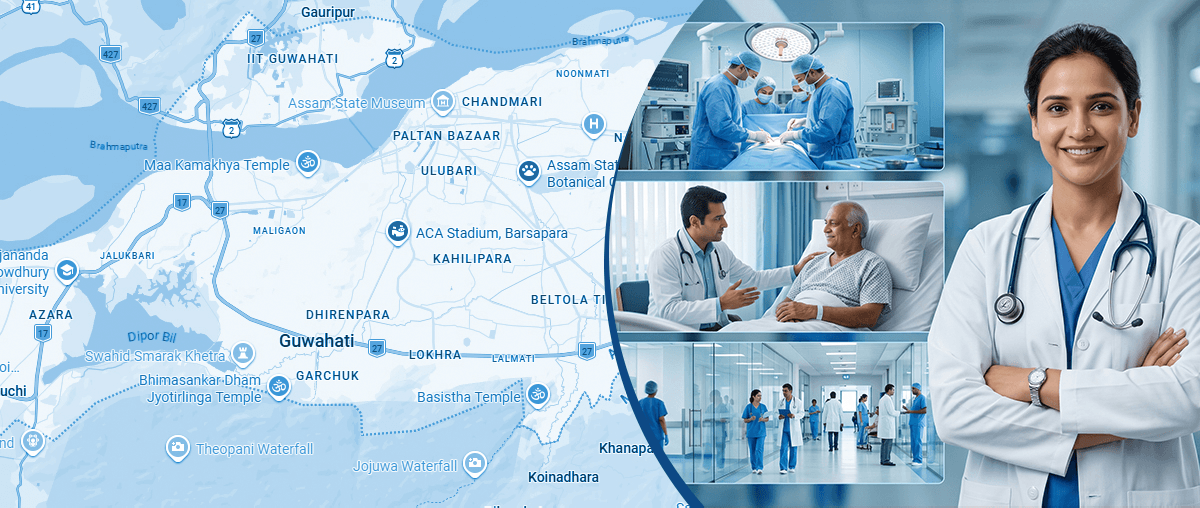

The rise of quality healthcare services across North East India
There is a quiet revolution transforming the healthcare infrastructure scene in the North-Eastern states of the country, with Guwahati as its epicentre and Peerless Hospitals playing a key role in the metamorphosis.
The situation in the past
For the perspective, it is an accepted fact that there was an abysmal gap in the availability of quality healthcare in Assam about ten years ago. Even various government reports, be they from the North Eastern Council or the Ministry of Health of the central government, highlighted the paucity of medical infrastructure in the regions.
Even in 2023, there were about 7500 health and wellness centres as the only option for the people in the region for treatments. Sixty-three per cent of the surgeries performed in the are related to basic interventions like caesarean sections, cholecystectomy and appendectomies. For the rest, people travelled to other states. Seventy-three per cent of the patients with non-communicable diseases sought treatment from facilities outside of the region. The government hospitals were the only ones in the higher-tier healthcare, with scattered small private healthcare providers seeking to make their mark.
Not that all of it went unnoticed. The North Eastern Council, in its reports, has variously focused on the inadequate medical infrastructure, including a lack of trained healthcare staff and doctors. But it was constrained by various factors in remedying the situation on a war footing. Outcome-driven healthcare was an exception rather than the norm. But things are changing now.
Creation of man power capacity
The healthcare delivery system in Assam used to be defined by three cities -- Guwahati, Dibrugarh, and Silchar, as these three cities had the three main medical schools. Currently, there are nine, with others in various stages of completion. Naturally, there has been a huge accretion in the number of beds and in the quality of protocol-driven medical care. The government hospitals and the private caregivers are both to be lauded for this.
Given the changes in the policy environment and improved mobility infrastructure, national-level healthcare brands like Max and Apollo, including the Peerless Hospital, are moving in with trained and specialist healthcare professionals, a crucial component in the infrastructure that was very difficult to retain previously and was a major roadblock for the Peerless Hospital and other corporate brands to step into the state with their full infrastructure.
Creation of greater access
In effect, it means that now effective healthcare is being provided, and the infrastructure to provide healthcare services even in the far-flung areas is being set up, thus creating a support infrastructure for the corporate brands to move in. The government is doing its utmost to develop medical colleges so that the demand for more and more doctors can be met and effectively provide primary and secondary healthcare services.
Though one must admit that building the infrastructure and providing quality healthcare are not the same thing, as there is an inevitable time lag between one leading to the other. However, the good work that is being done is reflected in the indicators: the infant mortality rate, the maternity mortality rates etc. But there is no room for complacency as the type of disease incidence has also changed over the period. While infectious diseases like tuberculosis and malaria, which were common in Assam has largely been brought under control, non-communicable diseases, like lifestyle-related diseases, like hypertension and diabetes, are on the rise. There is one school of thought that suggests that the rise in the incidence of these diseases, cancer included, is brought about by the increase in the improvement in our diagnostic capabilities, that they were always there and had largely gone undetected and therefore untreated earlier.
Proliferation of diagnostic facilities
One of the key associates of the healthcare system is diagnostics. The proliferation of technologically advanced diagnostic facilities is, therefore, very encouraging. Take the Peerless Hospital, for example, we are hooked up to a tele-radiology firm, which gives us the freedom of not depending upon the 24X7 physical presence of a doctor to report on an MRI or CT, and still be extremely effective. The ASSIST or Assam State Secondary Healthcare Initiative for Service Delivery Transformation initiative of the government is also doing well to strengthen infrastructure in the different tiers, which in effect ensures that the tertiary sector caregivers remain unclogged.
In terms of private diagnostic centres, today almost all the big chains are here in Guwahati. Their proliferation in Silchar and Dibrugarh is also encouraging. However, in terms of hospitals, we do not have the big pan-India players, except for two hospitals one of them being the Peerless Hospital (250 beds, with 100 beds in operation in the Phase I) in the segment for non-local players. Other brands are also coming in.
In terms of competition, the new players will have to take the test of fire as the established players have already streamlined their occupancy, revenue models and service delivery mechanisms. Starting ground-up, the new players will definitely have to go through a gestation period.
Doctors are the key
One key factor in healthcare is the Doctor – his pedigree and capability. Having a three-year head start, Peerless is well placed to refurbish its centres of excellence and niche segments. The result will be the ushering in of outcome-based, organised healthcare in the state, which will put the patients in a win-win situation, as the private hospitals mostly follow the same Key Performance Indicators or KPI. It will not so much be about the pull of the respective brands as the quality of doctors providing the services. Peerless Hospitals in Kolkata, having served patients from the North East for three decades and the goodwill it has created not only for its excellent services, but also for being transparent and cost-efficient, will certainly be advantageous to Peerless Hospital, Guwahati, especially in competition with the big-ticket brands.
Outcome-based treatment is gaining ground
One need not overlook the fact that while the Western system of healthcare is totally outcome-based, in the Indian one, affordability is also a major factor, where Peerless enjoys a distinct advantage. However, to put things in the right perspective, one must admit that an “institution” in the private sector healthcare space is yet to emerge in Assam, and it still runs mostly based on the individual brand value of the doctors, which is perhaps why the attrition level among doctors is quite high. Doctors are also reluctant to join startup hospitals, as they lose out on the patient traffic that established hospitals are able to generate, apart from providing the necessary support facilities, both in terms of infrastructure and trained manpower. And the Peerless Hospital, given its brand value, again enjoys an advantage here.
Reliance on insurance-based payment is also a trigger to growth
With an increase in cosmopolitanism and declining dependence on cash-based transactions brought about by an increasing insurance penetration, the private healthcare space in Assam is witnessing a new kind of dynamism. Referral schemes from neighbouring states are also an important component, which is often not considered in discussions like these. The advantage of the Peerless Hospital, Guahati, is that it encourages patients to keep in touch post-treatment through follow-up tele-conferencing and other digital communication channels. In a transport infrastructure-challenged region, this is again an advantage that this hospital enjoys.
Trust as legacy helps
The legacy of Peerless in terms of trust – both in terms of excellence as a healthcare service provider and as an entity that is completely transparent in all spheres of its performance – is naturally the driving force behind the Guwahati operations. The next obvious talking point will be Centres of Excellence – Cardiology, Critical Care, Neuro Sciences (both surgical and non-surgical), and Kidney Sciences, which are our focus areas. The hospital has been able to develop two already, Cardiology and Critical Care, while capabilities in Neurosciences are also improving at a fast pace. What needs to be noted here is that it is not merely about conducting very complex procedures, but more about repeatedly giving a high positive outcome. This is a time-consuming exercise, where human resources are enriched with experience, and other resources are ploughed back from what is generated.
Cardiology (in terms of entire heart sciences) and Intensive Care are already well established, with the hospital’s ICU facilities being lauded across the city for the pedigree of the specialised caregivers, the protocols that are strictly adhered to, and the consistently good outcomes. Consultations with the Government for permissions to move into many critical areas of caregiving, especially surgical, are ongoing and as soon as the hospital gets the nod, these services will also be on the cards.
Peerless Guwahati is a multi-speciality hospital with advanced infrastructure for critical care, cardiology, kidney sciences, and Neurology already in place. Almost all vacancies have been filled with qualified personnel, all processes and systems have already been checked with cases of various complexities, supply chains have been tested, and outcomes have been monitored. All the boxes have been ticked, and the hospital is confident of going full steam ahead well within a very short period of time, with more beds to support more patients looking for advanced care at affordable rates.
End words:
The Peerless Hospital, as an outcome-based multispeciality hospital, is among the pioneers with national-level branding to set foot in Guahati. With affordable healthcare services, it fills a major void in the North East. To learn more about the best evidence-based medical practices in current time, visit the website of Peerless Group.
Popular Searches
Peerless One | Peerless Hospital Kolkata | Hospital in India | Big Hospital in Kolkata | Multispecialty Care | Best Multispecialty Hospital | Best Hospital in Kolkata
You may also like

The incidence of cases requiring neurosurgical intervention is on the rise globally, and India is no exception.
Read More
Just having cancer is not enough to threaten mortality.
Read More
Paediatric surgery is different from general surgery primarily because paediatric surgeons have to deal with very small patients.
Read More
Walk down any street in Kolkata, and you are, in a sense, walking through history.
Read More
Are You at Risk? A Checklist for Heart Health
Mar 19, 2026Heart attacks have assumed frightening proportions in India. Not only is there an increased incidence of the disease, but the way it has crossed the rural-urban and rich-poor divides to attain universality has raised alarm bells.
Read More