




The Best Exercises for Knock Knees (No Gym Needed)
Written by PeerlessOne on 03-07-2026
Medically Reviewed by Dr. Sudipto Mukherjee (DNB - Orthopaedics)
Last Update on 04-07-2026
Table of Content
- What are Knock Knees?
1.1 Simple Definition
1.2 Structural vs. Postural Knock Knees
1.3 Normal vs. Abnormal Q-Angle
1.4 Who Gets Knock Knees? - What Causes Knock Knees in Adults?
2.1 Genetics and Bone Structure
2.2 Obesity and Excess Body Weight
2.3 Vitamin D Deficiency
2.4 Flat Feet and Overpronation
2.5 Weak Hip Abductors and Glutes
2.6 Previous Knee Injury or Surgery - How to Check Your Knock Knees at Home
3.1 Step-by-Step Ankle Gap Measurement Test
3.2 Mild vs Moderate vs Severe Classification
3.3 Signs You Need a Doctor Before Starting Exercises
3.4 Red Flags: Pain, Swelling, Locking Knee - Which Muscles Cause Knock Knees and Which Ones Fix Them?
4.1 Hip Abductors
4.2 Glute Medius and Glute Maximus
4.3 Quadriceps and Knee Tracking
4.4 Hamstrings and Inner Thighs
4.5 Importance of Targeting the Right Muscles - 10 Best Exercises for Knock Knees (No Gym Needed)
5.1 Clamshells
5.2 Side-Lying Leg Raises
5.3 Lateral Band Walks
5.4 Sumo Squats
5.5 Wall Squat with Ball Squeeze
5.6 Single-Leg Glute Bridge
5.7 Reverse Lunge with Knee Tracking
5.8 Side Lunges
5.9 Monster Walks
5.10 Butterfly Stretch - 4-Week Knock Knees Workout Plan (At Home, No Equipment)
6.1 How to Use This Plan
6.2 Weeks 1–2: Foundation Phase
6.3 Weeks 3–4: Progression Phase
6.4 How to Track Your Progress
6.5 What to Do After Week 4 - Best Stretches to Support Your Knock Knees Workout
7.1 IT Band Stretch
7.2 Pigeon Pose
7.3 Hip Flexor Stretch
7.4 Foam Roller Technique
7.5 How Often to Stretch vs Strengthen - Exercises to Avoid with Knock Knees
8.1 Narrow Stance Deep Squats
8.2 Hard Surface Running
8.3 Uncontrolled Plyometrics
8.4 Common Mistakes People Make
8.5 Leg Press with Knees Caving Inward - Lifestyle Changes That Speed Up Knock Knees Recovery
9.1 Footwear and Orthotics
9.2 Best Sleeping Position
9.3 Correct Sitting and Standing Habits
9.4 Diet and Weight Management - Can Knock Knees Be Healed in Adults?
10.1 Realistic Results Timeline
10.2 Factors That Affect Recovery Speed
10.3 Postural vs Structural Knock Knees
10.4 When Physiotherapy or Medical Intervention Is Needed - FAQs About Knock Knees Exercises
11.1 Can Knock Knees Be Fixed Without Surgery?
11.2 How Long Does It Take to Correct Knock Knees?
11.3 Is Walking Good for Knock Knees?
11.4 Are Knock Knees Genetic?
11.5 Can Knock Knees Cause Knee Pain?
11.6 How Often Should You Exercise?
11.7 Do Knock Knees Get Worse with Age?
11.8 Best Exercises to Fix Knock Knees Fast - Conclusion
12.1 Recap of the 4-Week Plan
12.2 Importance of Consistency
12.3 Bookmark the Workout Plan
12.4 Disclaimer & Professional Consultation Advice
What are knock knees?
Simple definition
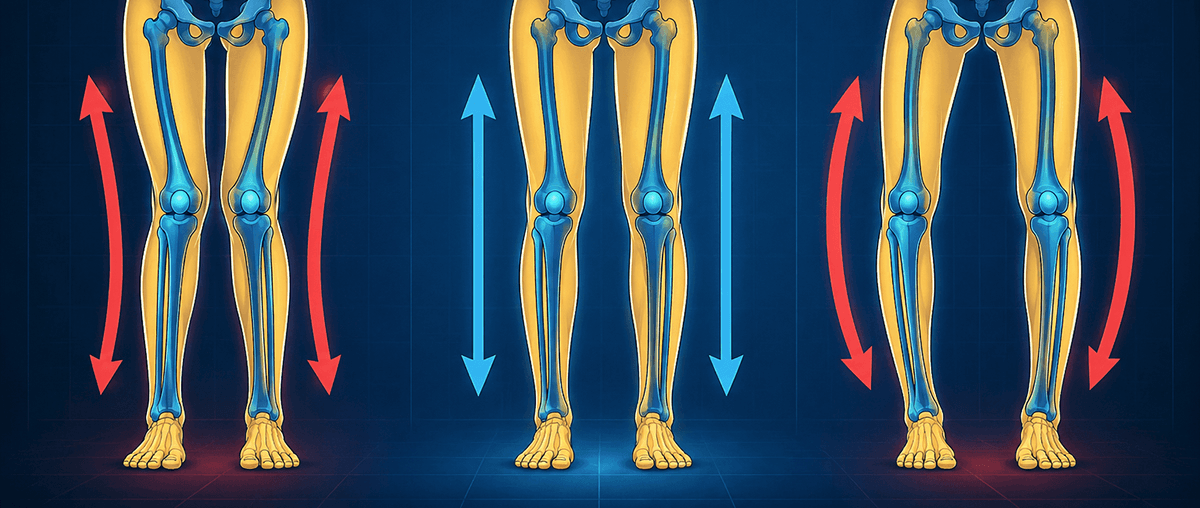
In India, most of the people discard the deformities in their initial stage as a temporary condition that later on develops into a serious concern. Knock knees, or Genu Valgum, refer to a condition where the knees bend inward and come together when standing straight. This alignment condition, for a long time, can give rise to sharp pain, joint damage, and mark the onset of knee arthritis.
Structural vs. postural knock knees - key difference
However, it is crucial to understand that all the knock knees are not the same, and these alignment issues can be of two different types, such as structural and postural knock knees.
Structural knock knees stem from the real changes in bone alignment, and it often takes place due to growth. On the contrary note, the postural knock knees result from muscle imbalances, poor patterns of movements, and lifestyle habits. Knowing the key differences is beneficial for helping you to choose the right solution.
Normal Q-angle vs. abnormal - what the numbers mean
Another notable aspect is the Q-angle that measures the angle between the knee and hip. When this knee angle becomes too large, it indicates an abnormal Q-angle. As per data, the typical range of Q-angle for men is around 10 degrees to 15 degrees, while for women, the range is 15 degrees to 22 degrees.
Who gets it: children, adults, athletes, overweight individuals
Knock knees can affect a wide range of people, such as children, adults, and athletes, due to numerous factors. In this guide of Peerless Hospital, we will dive into the fundamentals of knock knees and shed light on the nitty-gritty aspects related to the knock knees workout to help individuals regain their vitality.
What causes knock knees in adults?
Although knock knees are quite common among toddlers, whenever they happen with adults, it is considered to be an underlying structural issue or a lifestyle issue. Once you spot your knees drifting inward, it's high time to watch out for the primary causes.
Genetics and bone structure-
Sometimes, the knee-related deformities or the alignment issues are present from birth. At our Peerless hospital in Kolkata, we are regularly dealing with multiple knock knees cases that stem from genetic predispositions. Plus, if your family history includes skeletal dysplasia, you are more likely to develop knee-related deformities or knock knees in adulthood.
Obesity and excess body weight-
Body weight plays a pivotal role in reality, and it leaves an impact on joint alignment. Remember that your excess body weight can add extra load on your knee joint, and as a result, structural collapse of the inner knee compartment takes place.
Vitamin-D Deficiency-
Bone health relies heavily on nutrients in the human body. Here is why the deficiency of Vitamin D and minerals can accelerate the erosion of bones. Besides that, deformities like Rickets begin to reveal their signs and symptoms from early childhood. It mainly results in knocking of the knees, and it cannot be healed in adulthood.
Flat feet and overpronation-
When you have flat feet, your arches will automatically collapse, and at the same time, it will force your ankles to roll inward. Such kind of inward rotation in reality takes a toll on the mobility of the individuals.
Weak hip abductors and gluteus-
All knock knees do not stem from the same sources, and often they take place due to postural issues. When the muscles become weak, the thighs tend to cave inward during the movement. As a result, a functional misalignment happens, and it gradually becomes a permanent postural issue.
Previous knee injury or surgery-
A slight to severe injury can be a major culprit behind the knock knees. A fracture that may have healed improperly, a ligament tear, or maybe some other form of trauma, leaves the knee joint unstable. Owing to that, the knees gradually tilt inward over time.
Remember that knock knees among adults is not a mere aesthetic concern, they can ultimately lead to premature osteoarthritis. If you ever witness these alignment-related issues, consult a specialist immediately.
How to check your knock knees at home?
Although the issues of knock knees are quite common among children, they appear to be red flags that need immediate medical intervention. How will I check or assess the knock knees-related problems? Worry not, and pay attention to the pointers below to identify how you can assess the knock knees from the comfort of your home.
Step By Step Ankle Gap Measurement Test
Performing the ankle gap measurement test is no longer a difficult job; with our step-by-step guide, you can do it with ease. To opt for knock knees treatment without surgery, it's crucial to conduct an ankle gap measurement test. One of the most reliable ways of self-assessment is measuring the intermalleolar distance. Let's dive into the steps below to do it yourself.
- Stand in front of a mirror and remove both your socks and shoes.
- Now, stand on your knees and keep the kneecaps facing directly forward.
- Use a measuring tape to measure the distance between the insides of the ankle bones.
Mild/ Moderate/ Severe - How to Classify your case
Once you are done measuring, it's time to categorise the severity of the inward tilt.
- If the ankle gap is less than 2.5 cm, it enunciates the normal range for adults. So, categorise it as mild.
- If you find the gap is 2.5 cm and 7.5 cm, you must consider it to be a moderately severe case. In this stage, the pressure on the outer knee compartment begins to weigh heavily.
- Lastly, the gap that exceeds 7.5 cm is severe and needs immediate medical intervention- earlier the better.
Signs you need a doctor before starting exercises
Before you directly jump into the knock knees workout, it is crucial to consult a medical professional. Self-assessment and self-treatment are not always safe if the underlying condition is degenerative.
Red flags: pain, swelling, locking knee
Here are some of the red flags that demand immediate professional help. Let's have a look at the factors below.
- When a knee knocks inward, and the other one is straight.
- A sharp, painful sensation in the knee, ankle, and hip.
- Visible signs of inflammation around the joint.
Which muscles cause knock knees, and which ones fix them?
The knock knees primarily stem from the tight hip abductors, gluteus, and medial quadriceps.
Hip abductors: the #1 muscle group to strengthen-
The hip abductors are, in reality, one of the most critical muscle groups for correcting the issues related to knock-knees. Situated on the outside of the hip, its primary job is to pull the leg away from midline. However, when these muscles become too weak, knock knees occur.
Gluteus medius and gluteus maximus role-
Knock knees mainly happen due to weak glutes, and most importantly, when the gluteus medius fails to stabilise the hip, it causes the knees to cave inward. However, the effective knock knee exercises at home aid in correcting this problem and restore the quality of life.
Quadriceps and knee tracking connection-
In the context of the quadriceps, the inner quads must be balanced with the outer quads. Otherwise, the extremely tight outer quads can create imbalances and lead to inward knees.
Hamstrings and inner thighs-
The overactive inner thighs are also conducive to knock knees, and here is why it is important to strengthen the hamstrings for stabilising the joint from within.
Why does targeting the right muscles matter more than exercise count?
When it comes to knock knees correction exercises, targeting the right muscle is vital. Otherwise, you won't be able to reach your goal only by performing the exercises. For instance, you can perform squats daily for 50 to 100 times, but if your glutes are weak, you will never be able to correct the knock knees.
10 best exercises for knock knees(no gym needed)
Struggling to cope with the knock knees-related challenges? Worry not, the right choice of knock knees exercises at home can help you out. The best part is that to improve muscular support, you don't need any heavy machinery or equipment. Have a look at the 10 best exercises for knock knees to overcome the difficulties with ease.
Clamshells - Hip abductor activation
Clamshells are a gold standard workout for correcting knock knees. It primarily targets the gluteus medius and prevents the knees from carving inward.
Side-lying leg raises- outer hip strengthening
This particular exercise is quite simple and helps to strengthen the outer hip area. It also helps to build a lateral wall around the abductor group to keep the legs straight.
Lateral band walks- glute medius isolation
For performing the lateral band walks, a resistance band is required, and you can also do it without this band. It teaches the hips to stay active during the movement.
Sumo squats- inner thigh + glute engagement
These squats are there to emphasize the engagement between the inner thigh and the glute. It only takes part in strengthening the glutes, and it enables the abductors to work in a controlled way.
Wall squat with ball squeeze - VMO+ abductor balance
This specific workout is crucial for VMO and abductor balance. It also activates the inner quad muscle.
Single-leg gluteus bridge- hip stability and control
It's in reality a powerhouse move for hip stability and control. This workout reduces the chances of “pelvic drop” that contributes to knock knees.
Reverse lunge with knee tracking- functional alignment
Reverse lunge with knee tracking focuses mainly on functional alignment. It improves hip strength through real-world movements.
Side lunges - multi-plane hip and knee strength
These workouts are conducive to providing multi-plane strength. They also stretch the tight inner thigh muscles.
Monster walks - dynamic hip abductor loading
Monster walks are a dynamic hip abductor loading exercise that allows individuals to step forward and outward at a 45-degree angle. It is beneficial for training the hips to maintain an open position.
Butterfly stretch - hip and abductor mobility
Last but not least, the butterfly stretch is helpful for improving hip and abductor mobility. This exercise enables stretching the inner thighs, and as a result, it reduces the pull.
4 week knock knees workout plan(at home, no equipment)
Knock knees require the knee alignment exercises to bring back mobility. Here is a no-equipment and 4-week-long blueprint for strengthening your knees and their associated muscles from within.
How to use this plan: frequency, rest days, warm-up
Consistency is always the key when it is concerned about knock knees-related exercises.
Frequency-
Perform the recommended workouts at least 3 to 4 days every week. To get quick and effective results, you can practice them daily.
Rest Days-
We suggest the individuals maintain a 24-hour gap between sessions for better muscle recovery.
Warm up-
Before you jump into the core exercises, it is important to invest 5 minutes in performing the dynamic movements, such as leg swings and others.
Weeks 1-2: phase of foundation
Start practicing by warming up the weak and sleepy muscles.
| Name of exercise | Sets |
| Clamshells | 3x15 per side |
| Wall sits | 3x12 per side |
| Side-lying leg raises | 3x30 seconds |
Weeks 3-4: phase of progression
Once you become familiar with how to warm up the muscles, it's necessary to perform the core exercises.
| Name of exercises | Sets |
| Side lunges | 3x12 per side |
| Bird-dog | 3x15 per side |
| Single-leg glute bridges | 3x10 per side |
| Wall sits with abduction | 3x45 seconds |
How to track your progress
Tracking your progress is a significant part of this practice. Keep an eye on these three metrics below to identify your progress.
Measure the gap-
Always measure the distance between your ankles.
Check knee cave-
Record the entire session of the workout to identify if the knee cave is still tilting inward or not.
What to do after week 4
Correcting knock knees is an ongoing journey, and here is why don't stop after week 4. Rather, continue the exercises like clamshells and side lunges.
Best stretches to support you knock knees workout
After muscle strengthening, it's high time to indulge in stretching for stabilising the tight issues and minimising the pulling effect.
IT band stretch-
To do this stretching with ease, cross one leg behind the other and lean towards the front leg side. This practice, in reality, reduces lateral tension.
Pigeon pose-
This particular pose targets external rotators and is beneficial for correcting knock knees.
Hip flexor stretch-
It is a deep lunge with the back knee down, and it also intends to correct the posture.
Foam roller technique for outer thigh and glute-
This technique mainly targets the tightness associated with the thigh and results in an inward pull. Tight glutes are also responsible for poor hip control. But the foam rolling technique helps to release the side hip muscles.
How often stretch vs strengthen
Both stretching and strengthening exercises should be performed 3-5 times per week for noticeable improvements in alignment. Although stretching can be performed regularly, for strengthening exercises, it is recommended to limit 3 to 4 days in a week. Otherwise, it may lead to fatigue and poor form.
Exercises to avoid with knock knees
As knock knees are a certain condition of alignment, certain moves can exacerbate the valgus stress. Here are some of the moves that you must avoid if you are suffering from knock knees-related problems.
Narrow stance deep squats-
When your hips are tight, these squats force the knees inward and enhance the valgus stress.
Hard surface running-
Stay away from hard-surface running, which may cause misalignment.
Uncontrolled plyometrics-
Avoid jumping or landing before you achieve complete control over your knee. Otherwise, it can result in an injury.
The mistake most people make-
Most often, people choose harder training instead of smarter practices. If your knees continue to tilt inward despite the exercises, it is a clear sign that you are just reinforcing a bad pattern.
Leg press with knees caving inward-
The individuals who are suffering from knock knees must skip the leg press with knees caving inward to stay away from increased stress on lateral knee compartment and greater strain on ligaments. It can also increase the pain and bring instability.
Lifestyle changes that speed up the healing of knock knees
The adult knock knees happen due to lifestyle factors, and here is why: to speed up the recovery from it, certain changes in lifestyle are required.
Footwear Modification and Orthotics-
Say goodbye to the flimsy flats and switch to shoes that come with strong arch support. When the overpronation is severe, we suggest resorting to custom insoles.
Sleeping position that reduces knee stress-
Sleep with a firm pillow between your knees for keeping the hip neutral. On the other hand, it also prevents the top knee from dropping inward.
Ways of sitting and standing correctly-
Avoid crossing your legs while sitting. Plus, don't forget to keep your kneecaps pointing straight ahead when standing.
Diet-
Remember, every extra pound weighs heavily on your knees. So, it is important to choose the diet strategically. Consume Calcium and Vitamin D enriched food items for bone density and to avoid obesity.
Can knock knees be healed in adults? (Realistic results timeline)?
What to expect
During the knock knees exercise session, only consistency is the key. Here is a realistic roadmap to follow for the postural correction.
| Timeline | Expectations |
| 4 weeks | Improved muscle strength and less arching after walks |
| 3 months | Significant reduction in the gap between the knees |
| 6 months | Strong hip abductors |
Factors that affect how fast you see results
Multiple factors influence the journey of recovery from knock knees. Let's have a look at the pointers below.
Age and skeletal maturity-
The strengthening exercises that are designed for correcting knock knees can improve the muscle balance and alleviate the pain. However, the pace of recovery depends upon your age and skeletal maturity.
Severity-
The pace of the results is also dependent on the severity. For instance, if the case is mild, you will witness faster progress, and the severe cases take time to heal completely.
Consistency-
Regular practice of the exercises also leaves an influence on how quickly you will get rid of the knock knees.
Lifestyle factors-
Lastly, maintaining a healthy weight, wearing proper footwear, and careful selection of diet are important for accelerating the recovery.
Postural knock knees vs. structural - different outcomes
Postural knock knees result from soft tissues and neuromuscular factors and these conditions are quite common among adults, athletes and individuals with sedentary lifestyles. The symptoms include knee pain, instability and no deformity.
Structural knock knees refer to the fixed bone deformity. Here the symptoms include visible deformities, pain and enhanced risk of knee compartment stress.
When physiotherapy or medical intervention is needed
The postural knock knees can be corrected only by performing the exercises at home, while structural cases require physiotherapy and immediate medical intervention.
FAQs about knock knees exercises:
Can knock knees be fixed without surgery?
Yes, there are many cases where physiotherapy and targeted quad exercises for knock knees can improve the condition of the patients without surgery. However, consulting a professional is important to understand the severity of the issue.
How long does it take to correct knock knees with exercise?
To get the best results, consistency is crucial. Continue the workout for 3 to 6 months regularly.
Is walking good for knock knees?
Yes, walking is always beneficial for health, but you must have to follow the right alignment.
Are knock knees genetic, or can they be fixed?
Knock knees can be of both types. If your knock knees are genetic, it is important to strengthen your hip abductors.
Can knock knees cause knee pain?
Yes, knock knees can cause pain in the hip, ankles, and lower back areas due to the uneven pressure on the knee joint.
How many times a week should I do knock knees exercises?
To get the best results, we recommend continuing at least 3 to 4 sessions per week.
Do knock knees get worse with age?
If the knock knees are left unaddressed, they might develop into osteoarthritis and take a severe form. That's why maintaining a healthy weight is vital.
What is the best exercise to fix knock knees fast?
Continue to practice clamshells and side-lying leg raises, and these practices are effective for strengthening the hip muscles.
Conclusion: Start your knock knees workout today
Recap of the 4-week plan and top exercises
Positive changes don't happen overnight, rather it happens with the right intent. To rise over the knock knees, following a 4 week long corrective plan is necessary, as it aids in building functional strength. The experts suggest focusing mainly on three movements, like clamshells, sumo squats, and side-lying leg raises.
Reminder to be consistent - results take time
However, in this journey of knock knees workout, consistency is your greatest ally.
Bookmark the workout plan
To perform better and to get desired results, save or bookmark this workout plan.
Disclaimer: Consult a physiotherapist for severe cases. Still, if you are experiencing sharp pain or severe misalignment, immediately consult with a physiotherapist to tailor the programme. Start now to get positive results. To know more orthopaedic related issues or to get more such insightful health-related information, visit the website of Peerless.
Popular Searches
Peerless One | Peerless Hospital Kolkata | Hospital in India | Big Hospital in Kolkata | Multispecialty Care | Best Multispecialty Hospital in Kolkata | Best Hospital in Kolkata
You may also like

In a world driven by computers and AI, it is but natural that the technology would take over the operation theatres for improved outcomes.
Read More
Best Home Remedy for Low Blood Pressure
Jun 4, 2026Have you ever stood up from a couch and felt a sudden dizzying tilt? If yes, then worry not
Read More
There is a quiet revolution transforming the healthcare infrastructure scene in the North-Eastern states of the country, with Guwahati as its epicentre and Peerless Hospitals playing a key role in the metamorphosis.
Read More
The incidence of cases requiring neurosurgical intervention is on the rise globally, and India is no exception.
Read More
Just having cancer is not enough to threaten mortality.
Read More